
How to Choose the Right Counting Scale: Capacity, Resolution, and Supervisor Control
February 3, 2026
Counting scales are essential in manufacturing, warehousing, and production environments where speed and accuracy are critical. Selecting the right scale requires more than just choosing capacity; resolution, part size, sample size, and supervisory control must also be considered to ensure accurate and reliable counts.
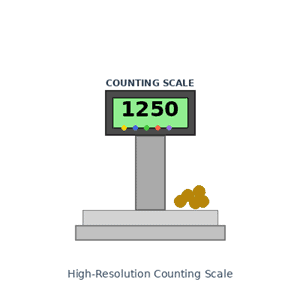
High-resolution counting scale for precision part counting
Modern counting scales from brands such as OHAUS, Adam Equipment, Avery Weigh-Tronix, and Setra incorporate advanced features like Supervisor Control and operator-restricted settings to maintain data integrity. These features are especially important in regulated laboratory and production environments.
Capacity: Know Your Load
The capacity of a counting scale is the maximum total weight it can accurately measure. Selecting insufficient capacity risks overloading the scale, while excessive capacity may reduce resolution and counting accuracy.
Examples:
- Counting hundreds of screws totaling 2 kg: a scale with a 5 kg capacity is appropriate.
- Counting tiny washers with a total batch weight of 200 g: a high-resolution scale with 0.01 g readability is ideal.
Resolution: Precision Matters
Resolution, also known as readability, defines the smallest weight increment the scale can detect. This factor is critical for calculating Average Piece Weight (APW).
- High resolution: Best for tiny parts, allowing smaller sample sizes and higher accuracy.
- Lower resolution: Suitable for larger parts or heavier batches but may require larger samples to maintain accuracy.
Examples:
- OHAUS Ranger 7000 series scales offer high resolution, ranging from 6 lb with 0.00002 lb readability to 70 lb with 0.0002 lb readability.
- Adam Equipment Cruiser CCTUH scales range from 8 kg with 0.05 g readability to 48 kg with 0.5 g readability.
- Setra Quick Count and Super Count scales range from 2.2 lb with 0.00002 lb readability to 110 lb with 0.002 lb readability, balancing capacity and precision.
Supervisor Control: Protecting Accuracy
Many advanced counting scales include Supervisor Control, a critical feature for regulated production lines and laboratories.
How it works:
- A supervisor sets scale parameters, including minimum accuracy percentages.
- The operator performs the sample count using the assigned piece quantity. If the correct sample is not detected, an alarm alerts the supervisor.
- Operator access is restricted, preventing changes to scale settings and avoiding accidental or intentional tampering.
This functionality ensures accuracy, traceability, and compliance, particularly in GLP and GMP environments or audit-sensitive operations.
The Role of Sample Counts
Counting scales rely on Average Piece Weight (APW) to calculate totals accurately.
- The operator places a verified sample of known quantity on the pan. Incorrect sample entry can create significant errors, such as entering 20 pieces when 21 are present, resulting in a 5% counting error.
- The scale calculates the APW. Many modern scales optimize APW dynamically as additional pieces are added.
- The calculated APW is applied to the remainder of the batch to determine the total count.
- This process compensates for natural weight variations between individual parts.
Supervisor Control ensures consistent sample size, prevents unauthorized APW changes, and maintains locked settings across operators and shifts.
Counting Scale Workflow with Supervisor Control
| Step | Responsible Person | Action | Accuracy Feature |
|---|---|---|---|
| 1 | Supervisor | Sets scale parameters including capacity, resolution, batch limits, and accuracy | Supervisor Control locks settings |
| 2 | Operator | Counts and places sample pieces on the pan | Verified sample used for APW |
| 3 | Scale | Calculates APW | High internal resolution |
| 4 | Operator | Adds remaining batch to scale | APW automatically applied |
| 5 | Scale | Displays final count | Logs stored and protected |
| 6 | Supervisor | Optional audit or review | System logs ensure traceability |
Balancing Capacity, Resolution, and Sample Size
- Use higher resolution for lightweight or tiny parts to improve accuracy.
- Use lower resolution for heavier parts and larger batches.
- Supervisor Control ensures consistent settings across operators and production runs.
Key Takeaways
- Capacity: Choose a scale that exceeds your largest batch without sacrificing resolution.
- Resolution: Higher resolution allows smaller sample sizes and more accurate APW.
- Supervisor Control: Prevents tampering and supports audit readiness.
- Sample Count Accuracy: Verified samples are critical for reliable totals.
- Integration: Connectivity options such as USB, RS-232, and Ethernet support data storage and traceability.
By selecting the correct capacity, resolution, and supervisor control features, facilities can reduce counting errors, improve productivity, and ensure data integrity.
Ready to improve your counting accuracy and maintain compliance? Contact Federal Scale and Balances to learn more about counting scales with Supervisor Control and advanced features from OHAUS, Adam Equipment, Avery Weigh-Tronix, and Setra.